
Jewell County Parole Versus Probation
Kansas separates terms that are often merged. Parole chiefly applies to older, indeterminate sentences and depends on eligibility plus a suitability decision by the Kansas Prisoner Review Board. Most determinate guideline prison sentences instead carry mandatory post-release supervision after prison. Probation comes from the sentencing court and may be managed through court services or community corrections. A person can leave prison while KDOC authority continues, or remain in the community under probation without ever serving a state prison term.
| Status | How it starts | Best source |
|---|---|---|
| Parole | Board approval for an eligible indeterminate sentence | KASPER, Board process records, and the decision order |
| Post-release supervision | Mandatory term after a determinate prison sentence | KASPER and the sentence record |
| Probation | Jewell County District Court order | Journal entry and assigned provider |
| Discharge | Formal end of sentence authority | Certificate, order, or updated official status |
Kansas VINE reports county-jail custody changes. It does not report KDOC prison supervision. KASPER covers KDOC-operated or funded programs, but not every Jewell County probation case. The criminal case remains the key local source because it names the sentence and can show revocation, transfer, or discharge.
- Parole
- Conditional community release after a Board decision under an eligible sentence.
- Probation
- A court-ordered community sentence.
- Post-release supervision
- A required control term after many determinate prison sentences.
- Discharge
- The formal end of the applicable sentence authority.
Check Jewell County Supervision Status
Start with the sentence, not the last facility. A Jewell County jail departure may lead to local probation, transfer, or no supervision. A KDOC prison release may lead to parole or post-release supervision. Use the KDOC number and Jewell County case number whenever possible so a similar name does not produce a false match.
- Search the KASPER offender repository by KDOC number, or use the exact name, aliases, birth details, conviction county, and supervision type.
- Read supervision type, movement data, and parole-office location together. Parole signals release from prison with active authority. Discharged is a stronger sentence-end status.
- For probation, search the Kansas court portal and obtain the Jewell County sentencing journal entry.
- Contact the office identified by the record. Ask whether supervision is active and which office holds it, within public disclosure limits.
- For exact proof, request the discharge certificate, supervision endpoint record, or public order.
KASPER has a major local verification limit. KDOC warns that community-corrections probation events after April 21, 2021 cannot display during modernization. A missing recent event must be checked against the sentencing order and responsible probation provider. The Jewell County released inmate search covers the full custody trail when the sentence type is unclear.
Jewell County Supervision Contacts
No one researched office handles every Jewell County supervision case. KASPER can display the parole-office location for a KDOC-supervised person. The court journal entry identifies whether local probation belongs to court services or community corrections. Find that designation before calling. It prevents a request from reaching an office that does not control the case.
Official routing points
KDOC status: Locating FAQ and KASPER fields
Parole authority: Kansas Prisoner Review Board
Probation record: Jewell County District Court, 307 N. Commercial, Mankato, KS 66956
Phone: 785-378-4030
Hours: 8:30 a.m. to noon and 1:00 p.m. to 4:30 p.m.
Give the KDOC number or case number and ask for public status and the responsible office. Do not seek protected treatment, counseling, or private supervision details. If staff cannot confirm a status, ask for the records custodian and the proper route for a focused public-record request.
Jewell County Absconder Records
KASPER includes Absconder as a supervision type. Under K.S.A. 75-5217(j), an absconder knowingly avoids supervision or makes their whereabouts unknown to the responsible parole, court-services, or community-corrections officer. That label shows unresolved supervision. It is not a release-completion status.
This distinctive Jewell County issue requires a second check. KDOC data can change, and the repository has display limits for newer community-corrections events. An absconder entry is not the same as a confirmed active warrant. Do not equate the two unless the proper agency verifies an executable warrant. The court docket may show a violation filing or warrant action, while the supervision office identifies the agency responsible for the case.
Conditions differ by sentence and order. They can concern reporting, travel, residence, contact, programming, and conduct, but no generic list proves the terms of one case. A violation can lead to added conditions, a hearing, custody, or revocation. The filed order and current agency record control.
Note: Kansas VINE reports county-jail custody events, not compliance with parole, probation, or post-release conditions.
Jewell County Supervision Discharge
Physical release and legal discharge are separate. K.S.A. 22-3722 and the Board process distinguish ongoing control from final discharge. For some indeterminate cases, supervision can continue to the maximum sentence. Early discharge may be requested or initiated when the law and record allow it. Reaching the lawful endpoint ends authority and results in a discharge certificate.
Proof should match the case. KASPER may display Discharged for a KDOC sentence, but a certificate or order is better when the exact date matters. Probation requires the Jewell County court record or provider confirmation. A closed docket can reflect administrative status rather than the date supervision ended. Separate cases may also create separate duties, so match each case number and sentence before concluding all supervision has ended.
Jewell County Parole Hearing Timeline
The Kansas Prisoner Review Board posts monthly public-comment material. Its session schedule and listed-residents page identify stages in the process, not confirmed releases. A researched July session linked to August eligibility hearings and possible September release. Possible is the key word. The Board may parole, continue a matter for more information, or pass the person for a stated period.
No official searchable database of individual Board decisions was located. Use the PRB process page for decision terms, then check KASPER after the expected event for a status or movement change. A focused KDOC or Board KORA request is the route to an available public decision or order.
The official listing pictured below helps establish process and timing. It does not establish release.
Open the current KDOC listed-residents source.
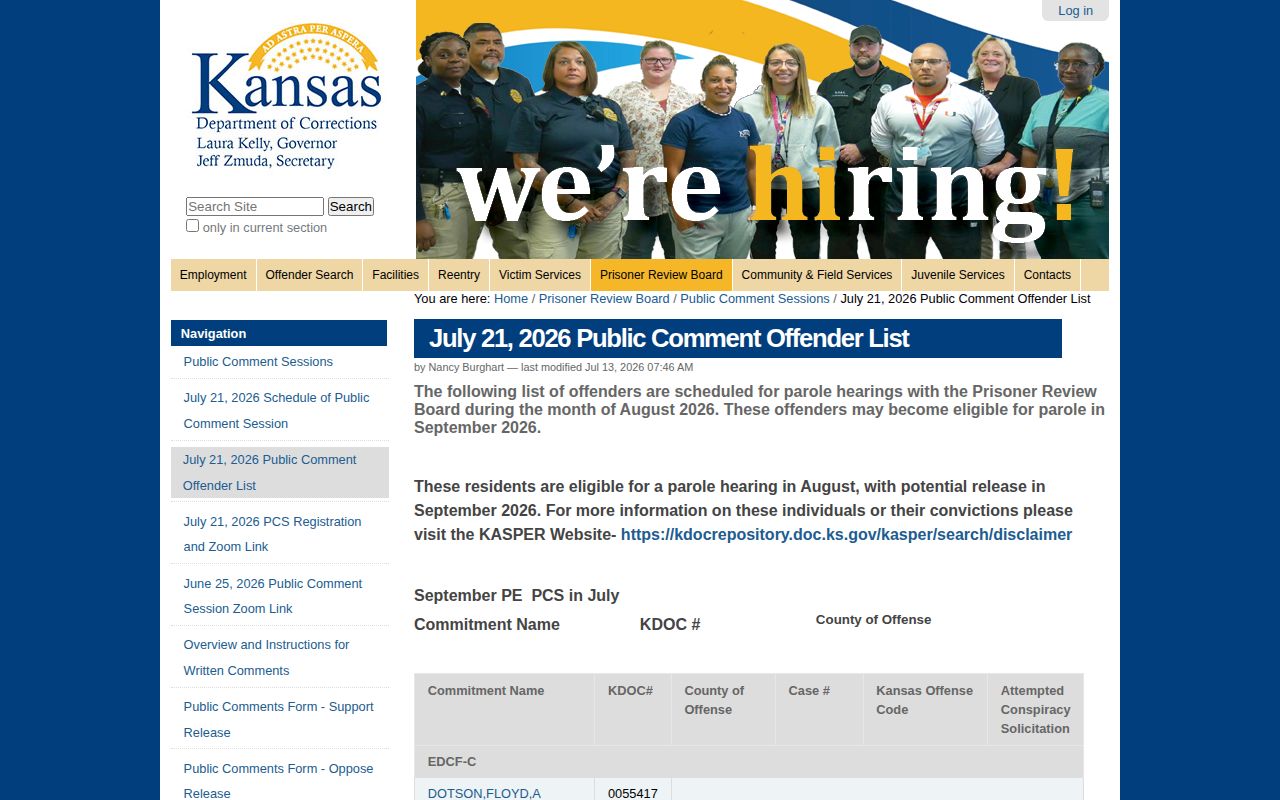
A later KASPER status change is stronger evidence of actual release than a name on the monthly list.
Jewell County Supervision Notifications
KDOC and Kansas VINE serve different populations. KDOC has a victim-notification route for qualifying state cases. Its form distinguishes KDOC offenders from people solely in county jail, on probation, or in community corrections outside KDOC supervision. Kansas VINE is described by the Attorney General as a county-jail custody notification service and excludes KDOC prison offenders.
Choose the system tied to the custodian. A VINE release or transfer alert does not establish parole, probation, or discharge. A KDOC notice does not replace the Jewell County jail record for a county-only booking. When a case crosses systems, preserve each notice and confirm the final event with the agency that held custody or supervision.
Note: A transfer is continued custody, while parole or post-release supervision is community release under continuing state authority.
Jewell County Supervision Records
A public status screen is useful, but it is not always the final record. KASPER can show a KDOC number, conviction description, Jewell County case information, movement dates, supervision type, anticipated release date, and parole-office location. Its data is updated on working days. Save the time of the check because a release, violation, office transfer, or discharge can occur before the next public update.
When the exact event matters, request the narrow record that answers it. For a KDOC case, identify the person by KDOC number, sentence, and case, then ask for the public supervision start, office assignment, release movement, discharge certificate, or decision order. KDOC may withhold protected correctional details under Kansas open-records exemptions, but a requester can ask for segregable public portions and the legal basis for each withholding. KASPER remains the readily disclosed baseline.
For Jewell County probation, obtain the sentencing journal entry first. Read later docket events in order for transfer, violation, revocation, modification, satisfaction, or discharge. Court case information and filed documents are not the same. Some public documents may require a courthouse terminal or clerk request if they are not downloadable online. Sealed and expunged matters, many juvenile records, and other protected material will not appear publicly.
Read Jewell Supervision Status Carefully
One status should not be stretched beyond its meaning. “Inmate” in KASPER indicates state custody. “Parole” or another supervision type can mean release from prison with continuing oversight. “Absconder” means supervision remains unresolved. “Discharged” is the strongest repository signal that the listed KDOC sentence authority ended, but it does not dispose of a separate county, federal, or registration matter.
A no-result also has several explanations. The person may have had only a county booking, received county time, bonded out, entered local probation, used a different name, or have a record affected by expungement. KASPER is not a complete Kansas criminal-history system. It should never be the sole source for a Jewell County arrestee who never entered a KDOC program.
Correction and expungement are different. A data correction addresses an inaccurate field and may be directed to KDOC at kdoc_pub@ks.gov with the specific disputed item. Expungement is a court remedy governed by offense-specific rules and requires an order. Neither process should be assumed from a blank result without checking the court and originating agency.
Public Record Search
Sponsored Results